Hexa Match: A Masterclass in Tessellation Logic and Spatial Optimization
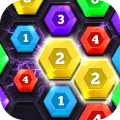
If you think Hexa Match is just a variation of standard grid puzzles, you haven't mastered the Six-Axis Geometry at its core. Unlike traditional square-based puzzles, this title utilizes a hexagonal grid that offers six points of contact for every tile, exponentially increasing the complexity of Spatial Planning and Pattern Recognition. You are tasked with placing and aligning colorful hexagonal units to trigger clearances, but success in the advanced stages requires you to move beyond simple matching into the realm of Geometric Forecasting.
On Gamesvio, we’ve analyzed the mechanics of this high-level logic game: your biggest enemy isn't the number of tiles—it's Grid Fragmentation. Whether you are executing a "Honeycomb Chain" or managing a cluttered board, success depends on your ability to maintain a contiguous workspace.
The "Honeycomb Perimeter" Placement Strategy
The primary reason players hit a "No-Move" Game Over in Hexa Match is "Island Formation"—placing tiles in the center and cutting off their own access to the edges. To dominate the high-score charts, you must implement the "Honeycomb Perimeter" Strategy.
Outer-Inward Loading: Always prioritize placing new tiles along the outer edges of the hexagonal grid first. By keeping the center of the board open, you ensure that you always have a "Universal Connector" space available for larger pieces that might appear in your queue.
The "V-Shape" Connector Logic: Because hexagons have six sides, they naturally form "V-shaped" pockets. Never fill a pocket unless it results in an immediate clearance. Instead, use these pockets as "anchors" to set up Tri-Directional Matches, where a single tile placement clears three or more surrounding hexagons simultaneously.
Color-Clustering vs. Scattering: In the mid-game, stop placing tiles of different colors adjacent to each other. Focus on "Color-Sectors." By grouping similar hues in specific quadrants of the grid, you increase the probability of a "Chain Reaction" when the required tile finally drops into your hand.
Logic Master’s Tactical Intel (FAQs)
Q1. Why do hexagonal grids feel more difficult to manage than square grids?
The difficulty lies in Radial Symmetry. In a square grid, you only account for two axes (X and Y). In Hexa Match, you are managing three axes of movement. This requires a different type of "Mental Rotation"—you must visualize how a piece fits not just horizontally or vertically, but diagonally across the 120-degree junctions.
Q2. How do I maximize my score during "Board Clears"?
High scores are tied to "Simultaneous Clearance" Multipliers. If you clear two separate groups of hexagons with a single tile, your points aren't just doubled—they are squared. The secret is to leave "one-tile gaps" in multiple clusters and wait for a single piece that can bridge the distance between them.
Q3. What is the "Ghost-Tile" indicator in the settings?
The Ghost-Tile is a Spatial Awareness Tool that shows you exactly where a piece will land before you release it. In the higher levels, where one wrong move can end the game, use the Ghost-Tile to check for "Hidden Overlaps" that might not be visible at high speeds.
Q4. Can I play Hexa Match on tablets without "Input Drifting"?
Absolutely. Hexa Match is built on a High-Precision Vector Engine specifically optimized for large touchscreens. To ensure the most accurate placement, we recommend using a "Drag-and-Drop" motion rather than a "Tap-to-Place" method. This allows you to "Hover" the piece over the grid to confirm the hexagonal alignment before committing to the move.























 Action & Adventure
 Arcade & Run
 Puzzle & Logic
 Sports & Racing
 Casual & Fun