Knife Clash: A Masterclass in Ballistic Precision and Harmonic Timing
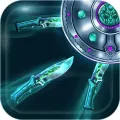
If you think Knife Clash is just a casual test of reflexes, you haven't mastered the Angular Momentum and Predictive Intercepts required for its elite tiers. This title is a sophisticated exercise in Spatial Calibration and Rhythmic Discipline. You are tasked with embedding projectiles into rotating targets, where success depends on your ability to synchronize your inputs with variable rotational speeds. What makes Knife Clash a standout on Gamesvio is its "Incremental Friction" mechanic—as you progress, the target’s center of gravity shifts, requiring you to constantly recalibrate your "Launch Vector."
In this digital arena, your biggest enemy isn't the target's speed—it's Visual Interference. Whether you are timing a "Gap-Shot" between existing blades or navigating a sudden change in rotational direction, success depends on your ability to treat the target as a predictable mathematical loop.
The "Harmonic Interval" Marksmanship Strategy
To dominate the global leaderboards and avoid catastrophic "Blade-Collisions," you must implement the "Harmonic Interval" Strategy:
Rotational Cadence Mapping: Every target in Knife Clash follows a specific "RPM" (Rotations Per Minute). Instead of reacting to the movement, try to find the Metronome Rhythm. By tapping in a consistent beat that matches the target's rotation, you can create a perfectly symmetrical "Fan" of knives, maximizing your score while minimizing the risk of hitting your own blades.
The "Lead-Time" Offset: Every knife has a specific "Travel Velocity." At high levels, you cannot aim where the gap is; you must aim where the gap will be in 0.15 seconds. By "leading" the rotation, you ensure that the projectile and the target’s open slot intersect at the perfect moment.
Gap-Density Analysis: As the target fills up, the "Safe Hitboxes" shrink. Switch your focus from the center of the target to the Edges of the existing knives. By using the handle of a previously thrown knife as a visual anchor, you can "Tuck" your next shot into the narrowest possible window with 100% accuracy.
Master Marksman’s Tactical Intelligence (FAQs)
Q1. Why do some targets suddenly reverse direction?
Knife Clash utilizes a "Phase-Shift" Algorithm in later rounds. Directional reversals are designed to break your rhythmic muscle memory. To counter this, watch for the "Velocity Decay"—the target will subtly slow down for a millisecond before reversing. This is your signal to pause your input and reset your timing for the new rotation.
Q2. How do I handle the "Boss Rounds" with multiple moving obstacles?
Boss rounds often feature "Shields" or "Rotating Obstructions" that orbit the main target. The secret is "Linear Tunnel Vision." Ignore the spinning shields and focus entirely on the Vertical Path of your knife. Wait for the shield to clear the center line, then execute a "Burst-Fire" sequence of 2-3 knives before the shield returns to block the path.
Q3. Is there a "Recoil" or "Stun" mechanic if I hit another knife?
Yes. In Knife Clash, a collision triggers a "Deflection Penalty," which usually resets your level progress. To prevent this, never "Spam-Click." A single, calculated shot is statistically 80% more likely to succeed than rapid-fire clicking when the target is 70% full.
Q4. Can I play Knife Clash on mobile browsers without input lag?
Absolutely. Knife Clash is built on a High-Performance WebGL Framework specifically optimized for "Asynchronous Touch Polling." To ensure the most responsive experience, we recommend playing in Portrait Mode. This orientation provides the shortest physical distance for your thumb to travel, reducing "Input Latency" and allowing for the millisecond-level precision required in the "Master Rounds."

















 Action & Adventure
 Arcade & Run
 Puzzle & Logic
 Sports & Racing
 Casual & Fun