Pool 8 Ball: A Masterclass in Kinetic Geometry and Friction-Based Physics
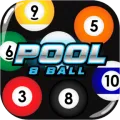
If you think Pool 8 Ball is just a game of hitting spheres into pockets, you haven't mastered the Angular Momentum and Vector Deceleration required for its professional tiers. This title is a sophisticated exercise in Geometric Precision and Spatial Forecasting. You are tasked with clearing a table of assigned solids or stripes, where success depends on your ability to calculate "Collisional Physics" across a high-friction felt surface. What makes Pool 8 Ball a standout on Gamesvio is its "High-Fidelity Physics Engine"—the game demands that you move beyond simple contact and master the art of "Cue-Ball Control" to dictate the layout of the table.
In this digital billiards hall, your biggest enemy isn't your opponent—it's Energy Dissipation. Whether you are executing a "Bank Shot" or managing a delicate "Safety Play," success depends on your ability to treat the table as a Closed Mathematical System.
The "Positional Geometry" and Friction Strategy
To dominate the table and achieve a "Total Clearance" run, you must implement the "Positional Geometry" Strategy:
Reflection Vector Mapping (The Diamond Rule): In Pool 8 Ball, the rails are not just boundaries; they are Reflective Surfaces. Use the "Mirrored Angle" logic—the angle at which the ball strikes the rail will be equal to its exit angle. By visualizing these "Bounce Lines" before striking, you can execute complex multi-rail bank shots that bypass obstructing balls.
Power-to-Deceleration Ratio: Most beginners hit the ball with too much force. Master the "Force-Stop" Technique. Calculate the amount of energy needed to reach the pocket and add exactly 10% for friction loss. This ensures the ball drops into the pocket while the cue ball remains in a "Neutral Zone," preventing an accidental "Scratch" or foul.
The "Next-Shot" Forecasting: Professional play is about "Strategic Sequencing." Before striking the current ball, identify the "Ideal Landing Zone" for the cue ball to set up your next shot. By controlling the "Resting Position" of the cue ball, you eliminate the need for difficult long-range shots, effectively "Shortening the Table."
Billiards Specialist Field Intelligence (FAQs)
Q1. Why does the cue ball sometimes follow the object ball into the pocket?
This is a physical phenomenon known as "Momentum Transfer." If you strike the cue ball in its dead center, it transfers all its forward energy to the object ball. To prevent this, use "Draw" or "Follow" techniques (adjusting the strike point on the cue ball) to create backspin or topspin, allowing you to control where the cue ball "settles" after the collision.
Q2. How do I handle a "Snookered" position where my path is blocked?
A snooker requires a "Kick Shot." Aim for a specific point on the side rail that will "reflect" the cue ball around the obstacle. The secret is to look at the Perpendicular Bisector between the cue ball and the target—aim for the rail point directly between them to achieve a perfect 1-rail escape.
Q3. What is the most effective "Break" technique?
In Pool 8 Ball, a successful break is about "Energy Distribution." Strike the "Head Ball" of the rack with maximum velocity while aiming for the center. This creates an "Explosive Dispersion," scattering the balls across the table and increasing the statistical probability of pocketing at least one ball to maintain your turn.
Q4. Is the game optimized for high-precision touch aiming on mobile?
Absolutely. Pool 8 Ball is built on a High-Performance WebGL Engine specifically optimized for "Sub-Pixel Aiming Sensitivity." To ensure the most accurate shots, we recommend playing in Landscape Mode. This wider perspective provides a superior view of the table’s "Geometric Plane," which is essential for aligning long-distance rail-to-pocket vectors.




















 Action & Adventure
 Arcade & Run
 Puzzle & Logic
 Sports & Racing
 Casual & Fun