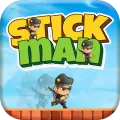
Stick Man: The Art of Physics and Perfect Momentum
There is something incredibly satisfying about the simplicity of Stick Man. In a world of complex 3D graphics, this game proves that all you really need for a masterpiece is great physics and a "hook." You play as a nimble stick figure swinging through the air like a high-flying acrobat. What I love most about this game is the "flow state"—that moment when you stop thinking about the controls and start feeling the rhythm of the swings. It’s a game of grace, timing, and knowing exactly when to let go.
The visual style is clean and minimalist, which is perfect because it keeps your eyes focused on the geometry of the level. Every anchor point is a new opportunity to gain speed or a potential disaster if you mistime your release. It’s the ultimate test of your internal sense of gravity and momentum.
The "Apex Release" Speed Strategy
Most players make the mistake of holding onto the rope for too long, which causes them to lose speed and swing in a slow, boring circle. To master Stick Man, you need to use the "Apex Release" strategy. The secret to maximum velocity is to release your hook exactly when your character reaches the lowest point of the swing arc. This converts all that gravitational energy into forward speed. If you need to gain height, hold the hook until you are just past the bottom and heading upward. Also, don't be afraid to skip anchor points! Sometimes the fastest way to clear a level is to "long-jump" across two or three anchors by using the momentum from a single, powerful swing.
Acrobat’s Master Intel (FAQs)
Q1. Why does my stickman sometimes "bounce" off the floor instead of crashing?
The game features "Elastic Physics" on certain surfaces. If you fall from a great height and land at a slight angle, you will bounce, which can actually be used to reach high platforms without using a hook. However, be careful—if you hit a flat surface directly from above at high speed, your momentum will reset to zero, making it much harder to get moving again.
Q2. How do I handle the levels with moving anchor points?
Moving anchors require "Predictive Hooking." Don't aim for where the anchor is right now; aim for where it will be in half a second. Tap the screen slightly before your character reaches the anchor's path. Once you are hooked, the moving anchor will act like a catapult, throwing you even further than a stationary one would.
Q3. Are the different skins just for looks, or do they change the gameplay?
While the skins (like the superhero or animal outfits) are primarily cosmetic, many players find that different "shapes" help them visualize the center of gravity better. A smaller, tighter skin might make it feel easier to navigate through narrow gaps, while a larger, brighter skin helps you keep track of your character during high-speed "screen-blurring" runs.














 Action & Adventure
 Arcade & Run
 Puzzle & Logic
 Sports & Racing
 Casual & Fun